 The Joint Group of Experts on the Scientific Aspects of Marine Environmental Protection addressed the problem of littering the marine environment by plastic and microplastics for decades. From the beginning, they focused mainly on microplastics, considering them an emerging concern, which would lead to the development of a scoping paper.
The international workshop held back in 2010 by GESAMP, centered on the microplastic particles as a vector for transporting persistent, bio-accumulating, and toxic substances in the ocean. The subject workshop was the first to convene representatives from the all interested parties, including but not limited to the chemicals industry, academia, policymakers, and intergovernmental organizations.
One of the conclusions made was that further evaluation of the potential impacts of microplastics was necessary. That led to the establishment of the GESAMP Working Group 40 (WG40) in 2012 to investigate the sources, fate, and effects of microplastics in the marine environment.
 This booklet is designed for Licensees, ship operators, shipyards, and marine engineers in general, to illustrate the Unified Technical File created for all MAN B&W engines, which is necessary to comply with the IMO regulation aimed at preventing air pollution.
The Unified Technical File serves as a document that outlines a procedure, primarily based on performance measurements, enabling the operator to confirm adherence to the IMO ‘NOx Technical Code’ to the Flag State Authority or their representative when the engine undergoes checks in service. MAN B&W Diesel has developed this booklet to partly elucidate survey procedures and partly serve as a reference manual for IMO definitions.
The initial section focuses on survey routines, from the testbed to the onboard situation, which is crucial for the operator, detailing the survey process from beginning to end. The subsequent section delves into specific topics and how to manage the most common tasks onboard, such as the spare or reconditioning parts addressed by the regulation. For general emission inquiries or emission control of MAN B&W two-stroke engines, references are made to existing materials published by MAN B&W Diesel.
Many of the initial Technical Files created by engine builders differed due to the varying requirements imposed by different classification societies. This variation occurred because the IMO Annex VI does not provide sufficiently detailed guidance on how to compile the Technical File in practice. MAN B&W Diesel has taken on the responsibility of coordinating efforts to prepare a standardized Technical File, intended for use by both licensees and classification societies. This responsibility also encompasses the necessary procedures for shipowners when subsequent engine adjustments or component changes take place.
 The objective of this questionnaire is to establish a standardized approach for collecting information about ships intended for the use of owners, operators, and charterers of vessels that transport liquefied gases in bulk, as well as for the terminals that handle such ships.
The phrase "Liquefied Gas Carrier" refers to vessels specifically engineered for the transportation of pressurized or refrigerated liquefied petroleum and chemical gases that possess a vapor pressure greater than 2.8 bar absolute at a temperature of 37.8°C, along with other products detailed in chapter 19 of the IGC Code, when transported in bulk, including those chemical carriers authorized for the transport of LPG and chemical gases.
While many owners already supply a ship information questionnaire, this document offers a suitable alternative where one is not available. The use of this questionnaire is entirely at the discretion of individual ship owners, operators, charterers, terminal operators, and other relevant parties.
It is anticipated that the Questionnaire will be completed in full only once during the lifespan of a ship, with minor adjustments to the recorded data being made as necessary should management, systems, or equipment undergo changes. Throughout the Questionnaire, if alternative responses are presented in the text, the response that does not apply should be removed.
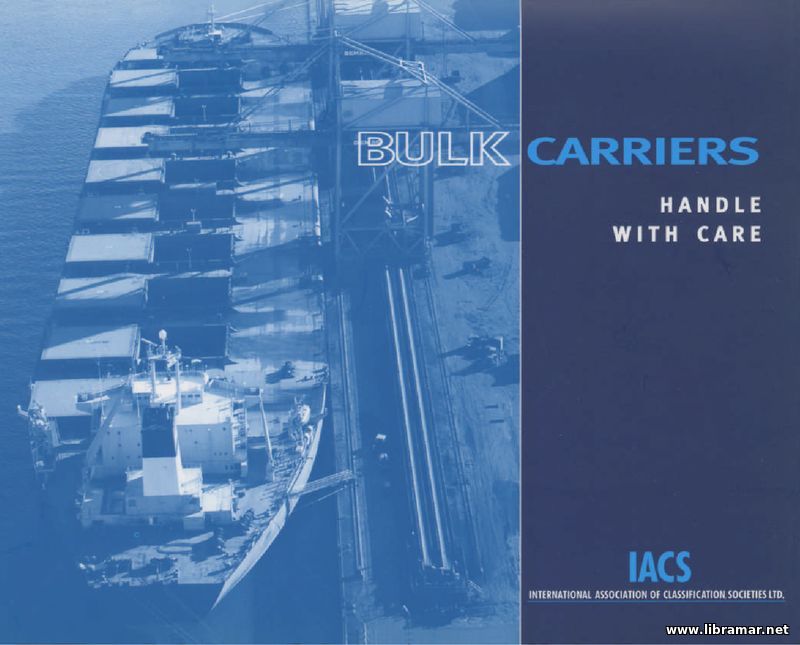 Nowadays, the tough conditions that are there at the market, are dictating the very intense operational demands on more than four-and-half thousand bulk carriers transporting nearly 30% of all of the world ocean cargoes. The cargoes having high density and weight - like coal or mineral ores - add some physical demands of the structures of the vessels, with particular focus made on their cargo hold areas.
For sure, the bulk carriers shall be handled with the extreme care both at sea and in the port. Ship's officers, stevedores bearing the responsibility for the cargo operations, as well as other involved parties, are the key ship safety partners since the lives of the seafarers depends on how careful the cargo is handled. Taking that into account, we understand how vital the proper ship-to-shore planning, exchange of information and good communication can be.
The present research conducted by IACS shows the readers that improper handling of high-density and heavy cargoes in the course of the loading/discharge may easily cause excessive stress which, in turn, may result in the physical damage to the ship's cargo holds and bulkheads. In the future, it may threaten the structural safety margins when the vessel is at sea during the severe weather condition.
 As we are all aware, the shipboard ORB, standing for the Oil Record Book, is the formal document, providing the official evidence of compliance of the ship with the relevant requirement and instructions, outlined in the MARPOL Oil Pollution Prevention Annex I. That is the main reason why the responsible personnel shall possess clear understanding and knowledge of how the entries shall be made to the Oil Record Book of their vessel.
The present guidebook is there to provide brief explanation of the nice codes that are normally use when recording the oil operations, supplemented with the real examples of their application. For instance, the Code A is dealing with the ballasting/fuel oil tank cleaning activities, that shall be duly recorded in the ship's Oil Record Book with proper identification of the ballasted tanks, and information related to the cleaning and ballasting processes, while the Code B addresses the dirty ballast discharge. In short, one has to know how to fill and maintain the ORB at all times.
 The ultimate guide of the author of the present guide was to explain the most important issues of the hatch cover security and also to steer the mariners towards active due maintenance of the hatch covers. It would definitely be less expensive to maintain the weathertight integrity of the hatch covers through the attention to detail and periodic checks and works, than to pay the possible claims for the wet-damaged cargo.
Moreover, it is critically important for safety at sea and for the protection of the sea environment to keep the covers weathertight and strong. We all know that leaking hatch covers are considered a principal cause of wetting of the transported cargo. The hatch covers may leak for various reasons, but the root cause is usually their poor maintenance of failure to close the covers properly.
The chapters of this guide provide the description of the hatch covers and their function, leakage problems and leak detection tests, some common false beliefs about hatch covers, tips on monitoring and inspection, procedures for proper maintenance and repair of the hatch covers, and also some necessary information relating to the safety of the operations. The appendices contain the procedures to opening and closing of the covers, and condition assessment forms.
 The main content of the present publication developed and officially published by Intertanko, is arranged in four main sections. The first section of the document addresses the Ballast Water Management Convention itself, providing some historical background and highlighting the important reporting related aspects.
The authors underlined the expectations of each involved party, including company DPS, Flag State, Classification Societies, as well as the manufacturers of the ballast water management systems installed on board ships. The second section is entirely devoted to the regulations by the USCG, standing for the United States Coast Guard.
The third section covers the contingency measures, including such critical matters as repair of the shipboard ballast water management systems at the loading port and at sea, different options for the ballast water exchange, mid-ocean exchange both with and without the use of the system, mobile treatment facilities and associated equipment, partial discharges and others.
Finally, the closing section and the two annexes contain all necessary reporting forms and a sample repair plan for the ballast water management system.
 We are all aware of the fact that mooring is deservedly considered one of the most difficult and hazardous activities for both ship crew members engaged in the subject operation and the port workers. Should something go not as planned, this can eventually result in disastrous consequences.
The present publication was compiled by the professionals of the world respected OCIMF entity with the intention to provide industry with the general and concise introduction to the mooring operation, and also to give necessary guidance on provision of safety.
The style of the text is very easy to follow so the publication can be used for the training of the seafarers at all levels, starting with the very beginners. Note that this fourth release of the title is aligned with the Mooring Equipment Guidelines and you are encouraged to use both volumes, since the latter will provide even more detailed overview of the design of the shipboard mooring systems and their proper technical maintenance.
The main emphasis has been made by the authors on the crew activities and due attention has been paid to the human factor, considering the huge number of cases where this factor played the key role – note that most of them could actually have been prevented.
|