 This book can offer its readers a clear and quite comprehensive presentation of the materials demonstrating the process of progression from the basic physical concepts to the real-life engineering applications and helping them easily see the whole practical significance of the fluid mechanics basics.
The broad variety of the topics included in the volume provides instructors with numerous options for teaching the courses and presents a very useful source of information for the students even after their graduation. The unique problem-solving approach applied by the author of the book has been presented at the very start of the publication and has been carefully integrated in all of the examples.
The way in which the material has been presented, makes it much easier to understand that in most of the other textbooks. The book has been widely recognized as one of the best references or first-time books for the students and professionals in the field of fluid mechanics. The author has also included some advanced text related to the viscous flow, and his efforts have eventually resulted in this resourceful and remarkably informative title. Excellent real-life example problems are supplementing the theoretical explanations making them much easier to follow and understand.
 This book on structural engineering is intended to provide industry with a well-balanced and seamless treatment of the established classic methods of analysis and modern computer-based techniques for the engineering structure design and conceptualizing. The principle goal of the volume is to foster a better understanding of the structural behavior on the basis of the problem-solving experience for the students of various fields of engineering who have exposed to fundamental concepts of mechanics.
While most of the other books on the same subject are mainly focusing in the manual analysis methods and their application to the idealized and simple structure, this one encourages students to duly develop their intuition connected with the structural behavior. The approach applied by the authors of the title will assist in the development of such type of intuition through presentation of the realistic and extensive problems together with the numerous case studies and computer simulation, allowing for the exploration of how the mechanical structures are responding to the changes in their physical parameters of geometry.
The content of the book has been found to be sufficiently comprehensive to be used for the students from elementary to high levels. The chapters have been organized by structural types and feature nine hundred figures and informative graphs.
 In his useful and infomative work, the author - Paulo Davim - volume has mainly focused on the very latest technological advances in various fields of mechanical engineering, trying to cover in a single volume such interesting topics as sustainability in mechanical engineering, magneto-rheological fluid technology, plus application of solar distillation systems, structural dynamics and visco-elastic passive damping treatments, tribological behavior of rare earth lube oils; thermomechanical modeling of multiphase steels, implementing STEP-NC language of machine control, optical real-time management for the auto-production lines, modeling/optimization of mechanical processes and associated systems, modeling of micromachining, micro milling, simulative tests and formability in modern sheet metal forming education, digital image processing in modern machining, and multimedia resources in engineering education.
The main intention of the author was to provide readers, including students and professionals, and even enthusiasts in this field, with the carefully compiled collection of the real examples demonstrating the research/development and also the education issues in contemporary mechanical engineering. The book is expected to be useful when looked at as the research book for the engineering courses and will definitely be of equal interest for researchers and academics, practicing engineers and other pros.
 The volume is providing a truly comprehensive coverage of both strain and stress analysis of the circular cylinders as well as of pressure vessels, and this is one of the most important classic topics of the theory and methodology of machine design. Most of the other books available today, are offering only a partial coverage of this subject and in the majority of cases they only consider the stress analysis in the elastic field; in the meantime, this book enlarges the design area and analyzes the processes occurring at pressures stressing the materials beyond their yield points and at thermal loads giving rise to creep.
This work by Vincenzo Vullo, who is professor at the University of Rome, teaching the mechanical design discipline, considers not only traditional but also advanced topics, ensuring that it will be useful to the machine design engineers and researches in this field. The relations that have been provided by the author, re intended to serve as a sound foundation for the design of those products that are considered safe and sophisticated from the technological point of view, and also complying with the requirements of the recognized technical codes and standards, plus for the developments of various innovative applications.
 We are introducing maybe the most popular and very highly respected publications on mechanics. This world recognized publication is mainly focusing on the development of the correct understanding of the fundamental principles rather than just addressing the specific methodologies.
The author of this volume, Irving Shames, has covered all basic principles instead of applying the "cookbook" approach and his also did his best trying to make this book more readable. This release of the volume is the latest available one and it includes more than five hundred completely new technical problems that have all been checked for accuracy by the author, very carefully and rigorously.
The topics of the book related to statics are covering the basics of mechanics, vector algebra and quantities, equilibrium equations, some introductory information on structural mechanics, and all other related topics, while the part of the book dedicated to the dynamics addresses particle dynamics, kinematics of rigid bodies including plane motion, dynamics relating to same, vibration matters etc.
The text presented by the author is deservedly considered as invaluable source of technical reference for students of mechanical engineering; they way material is presented makes the volume so reader-friendly and numerous examples allow the students understand the theory much easier.
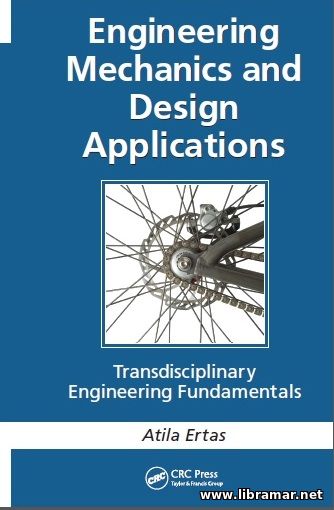 In the last years, the increasing number of the complex problems has required much more technical knowledge be possessed by the engineers to be able to address and mitigate them. Such problems include but are not limited to the design of various engineering systems and subsystems, their design/re-design and interaction of other systems.
The present publication by Atila Ertas presents readers the fundamental concepts of the mechanical engineering in the context of the design process, providing all of them, and especially non-mechanical engineers, with the required knowledge and understanding of the most important mechanical aspects of a project, thus making the collaboration in transdisciplinary teams a bit easier. The author as managed to combine in a single volume the statics and dynamics, together with the vibration and material strength, offering a practical reference for design.
The book starts with the comprehensive overview of the PtD, standing for the "prevention through design", giving an idea of the occupational HSE needs and presents the condensed introduction to the engineering statics and dynamics, failure theories and various dynamic loadings.
The content also includes numerous real-life examples of the design and analysis together with the practical applications demonstrating how exactly the transdisciplinary knowledge could be applied in practice. The book shall be suitable for the students willing to understand the basics of engineering mechanics, as well as the professionals in the industry.
 This comprehensive reference offers detailed information necessary for understanding and accurately assessing compressor capabilities, as well as for choosing the appropriate designs. Engineers and students will acquire a solid grasp of compression principles, equipment, applications, selection, sizing, installation, and maintenance.
Numerous examples effectively demonstrate essential elements to assist readers in comprehending the practical aspects of compressor technology. The third edition of Compressors: Selection and Sizing has been fully updated to incorporate new API standards.
Enhancements requested by readers include an additional section on diaphragm compressors within the reciprocating compressors chapter, along with a new section addressing rotor dynamics stability in the chapter dedicated to diaphragm compressors. The latest advancements are showcased in the fields of efficiency, 3-D geometry, electronics, CAD, and the utilization of plant computers.
The pivotal chapter on negotiating the acquisition of a compressor now aligns with contemporary industry practices for developing detailed specifications, conducting bid evaluations, performing engineering reviews, and overseeing installation. A significant chapter evaluates the reliability of different compressor types.
Within this book, you will discover all the necessary information to select the appropriate compressor for your specific application. It also encompasses practical insights into compression principles, equipment, applications, selection, sizing, installation, and maintenance. Additionally, new sections on diaphragm compressors and an introduction to rotor dynamics stability are included.
 The rapid advancements in technology have fundamentally altered our understanding and approach to measurement. Many instruments now taken for granted were simply unavailable when I began my engineering studies in the 1960s. At that time, a formal course in "Mechanical Measurements" was rare in Mechanical Engineering curricula; learning primarily occurred through hands-on laboratory experience.
Electrical Engineers were comparatively better prepared thanks to a dedicated year of study in "Electrical Measurements." Even when "Mechanical Measurements" was introduced later, the focus was predominantly on instrument descriptions, neglecting a comprehensive examination of underlying principles. As a result, mechanical engineers of that era often lacked a solid foundation in measurement error analysis, regression techniques, and related concepts.
Furthermore, the integrated circuit and digital computer were only beginning to emerge, setting the stage for revolutionary changes. These developments have shifted the focus of measurement from the instruments themselves to the measurement process. Modern approach emphasises the methodology, i.e. how to measure rather than which equipment to use. One strives to makes the most of available budget and resources to ensure that all the measurements are the best that they can be.
For close to two decades, I've been teaching a course originally titled "Measurements in Thermal Science," subsequently renamed "Measurements in Thermal Engineering," yet the course's core emphasis on the measurement process remains constant. Students dedicate roughly a third of the semester to understanding fundamental principles. With this understanding in place, they are well-prepared to tackle the measurement of quantities relevant to mechanical engineering. The course emphasises problem-solving skills, encouraging students to independently research instruments through available digital library resources.
|