 Metal corrosion and its prevention on boats is a widely misconceived topic that many boat owners, or boat builders write in their own way. Topics that are written about in yachting are often talked about in a way where only a corrosion engineer can only understand it's science and knowledge. Because of this, owners have found themselves seeking knowledge which has been made very difficult, and can now get a book of this sort to fill the gap.
It is good for an owner to have a good amount of knowledge of corrosion, in case they need it for metal boatbuilding as well as knowing the conditions that are appropriate for them to corrode. To make matters extremely important, the owners should take into account the safety. Choosing certain types of equipment can lead to problems, especially since chandlery folks aren't too knowledgeable regarding this topic. It is important to consider the topic of what can effect and interact with water is also important. It can be understood well without requiring the use of maths or any confusing science. However, there are theories out there that assist with finding a certain metal for a certain type of purpose. There are many factors that can effect how the corrosion of behaviour of metals so many rules are hard to follow.
It is known that metal has one main objective: to return to it's state (ores). Finding corrosion resistant items pays off great because of this. Spending more money will reward well. Choosing cheap material may have problems later on sinking the boat. Of course in writing information it is taken great consideration of different authors and their fields. And because there is experience between my boats from my work and naval architect, there may be a lot of information aired amongst practical boat owners with centreboard bolts.
 Sails are intricately connected in every aspect to the material from which they are constructed, making it impossible for any book that aims to explore them in detail to overlook the process of sailcloth production and the essential qualities it must possess. The sailmaker invests considerable care and expertise in selecting the cloth for your sail; therefore, it is important to recognize this knowledge when you encounter it, as it is integral to his profession.
Much hinges on his selection, so let us examine some of the factors he must take into account. Sailcloth is typically woven by arranging threads on the loom's beam to create the warp, or lengthwise threads, and then interlacing the thread back and forth over and under the warp to produce what is referred to as the weft.
The resulting weave is compacted by beating the weft, ensuring it lies closely together; the tighter the weave, the greater the cover factor, as the weft causes the warp to crimp. When tension is applied along the warp, the lengthwise threads tend to straighten their crimp and open the weft, which increases the cloth's porosity and diminishes its ability to retain any chemical fillers that may have been incorporated; the individual threads may also slightly untwist and elongate.
However, the stretch is minimal, and no significant deformation of the cloth occurs. Nevertheless, when tension is applied at an angle to the threadline, the small squares created by the weave become distorted into diamond shapes, causing the cloth to elongate in the direction of the tension and narrow across this line.
Consequently, the cloth shifts at right angles to a line of bias tension, resulting in a fold of additional material along this line; the outcome in a sail is increased draft along the tension line and a flattening in the area from which the cloth has been drawn. A quality cloth should not remain permanently deformed after such stress but should return to its original shape once the tension is released.
 Dynamite Payson's "Instant Boatbuilding" aims to guide readers in constructing 15 boats designed by Phil Bolger. It offers plans and instructions for a range of boat types, including skiffs, pirogues, and dinghies, and features Payson's well-regarded, practical advice. However, potential buyers should be aware that only a limited number of the 15 projects include fully detailed plans.
The remaining projects feature only scaled-down images, a potential drawback considering the book's title. Despite this, the book provides valuable introductory content on boatbuilding basics, tools, and materials. The instruction is clear and easy to understand, making it a useful starting point for beginners.
However, more experienced boatbuilders, or those seeking in-depth knowledge, will likely need to consult additional resources. While not a comprehensive manual, "Instant Boatbuilding" offers a foundation for aspiring boatbuilders. The main body of the book is supplemented with several appendixes providing additional information, and glossary explaining the most frequently used terms.
 Got boating questions bugging you? This book's got the answers! Inside, you'll find 101 super helpful sailing tips, straight from Duncan Wells, a top-notch sailing instructor. Think of it as your stress-free guide to smooth sailing – whether you're prepping for a trip or already out on the water. Duncan's sharing all his best tricks and know-how in a way that's easy to understand.
We're talking sail adjustments, perfect mooring, secure anchoring, smart navigation, tackling rough weather, and a whole lot more. Each tip is broken down with simple steps, clear photos, and diagrams, so you can quickly find what you need when you're facing a tricky situation.
You'll learn how to estimate tide speed like a pro, get your depth sounder spot-on, master the nautical rules of the road, figure out your hull's speed, use your chart plotter for tacking, make the most of reefing, keep your zips in shape, and even grab buoys from the cockpit. Seriously, the list goes on! This latest addition to Duncan Wells' hugely popular "Stress-Free" collection is a lifesaver for any boater who wants quick, practical advice to solve those everyday challenges out on the water.
 It is rare to find individuals who own boats or wish to possess them solely for enjoyment who do not select them – after all practical factors are considered – based on personal preference. A beautiful object brings eternal joy. In this regard, it is irrelevant whether a yacht is faster than another, whether it has won a single cup or a multitude of them.
From my experience sailing and collaborating with sailors, the appreciation of graceful design and structure in any vessel often leads to extensive and diverse discussions. Inevitably, comparisons arise, with lengthy lists of boat names long forgotten, the performance metrics of certain ocean greyhounds in conditions that only a fortunate few have ever encountered or would even desire to. Ships, yachts, and boats are frequently referred to using feminine pronouns.
The phrase “She rolled like a pig” is a common maritime expression for any vessel that misbehaves in a following sea. Similarly, “she” often receives more care, attention, and affection from her male owner than a girlfriend, fiancée, or wife, and to understand the reasons behind this, one would need to delve deep into the history of maritime traditions…
 We would definitely encourage every sailor to have a close look into the pages of this compact publication. Only around twenty pages, so this will not take too much of your time. You will get twenty-five tips which will for sure help you onboard. This collection of tips was compiled by the professional captain sailing onboard yachts everywhere around the world, so the book is worth reading.
According to the numerous feedbacks by the readers, primarily yacht and boat owners, the content of the book features practicality and is quite informative. In fact, it can be easily used as the pre-passage check sheet for the less experienced sailors, making sure all important items have been taken care of, and the format of the book allows to read through in just ten minutes.
Note that the author has also included the links to many useful materials. We all know how important it is to go to the sea well-prepared, and this small book will help you when preparing for the voyage and make sure it is safe.
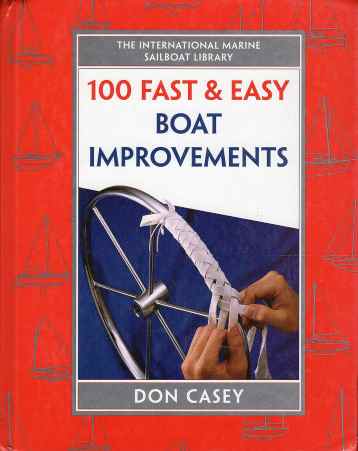 The book by Don Casey is there to provide readers with necessary information about different aspects of boat maintenance, namely about the improvements they could to do to their boats and yachts. First of all, obviously, the author touched the most important aspect – safety, addressing the areas where the improvements would result in the increase in the human safety; for example, it is handrails and locker latches, life-vest cushions and track protectors, bilge pump light and many others equally critical.
Then, there is time to add some convenience to your boating experience, and this can be reached by paying attention to the details of the stuff used regularly, such as the buckets and scrubbers, racks and trays, blocks, bins, tables and others. The comfort onboard your boat can be increased by working on the curtains and dishes, seat backs, doors, cleats etc. Above is just a small portion of what was covered by the author in this book. Take some time reading it and make sure that you do use the valuable advices to improve your boat and, consequently, your boating experience.
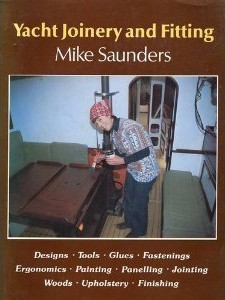 This book has been crafted to address a significant gap in the available literature on boat joinery. It primarily focuses on, but is not limited to, internal joinery and explores related topics such as timbers, tools, modern adhesives, and other materials used to affix wood. Today, most boats are no longer constructed entirely of wood, and yacht joinery has become a specialized trade where boat builders often employ 'fitters-out' rather than traditional shipwrights.
Therefore, this book aims to provide practical, reliable information for 'fitters-out', whether they are aspiring tradespeople, home constructors, or enthusiastic yachtsmen looking to build or install shelves and fixtures in the galley-those who might be unsure where to begin. The author prioritized clarity and specificity, offering concrete information rather than vague ideas.
Many of the designs included are ones the author has personally built or used, and relevant dimensions are provided wherever possible. However, the book does not claim to cover every aspect or method - there are many ways to achieve a goal, and nothing should prevent the use of alternative approaches.
|