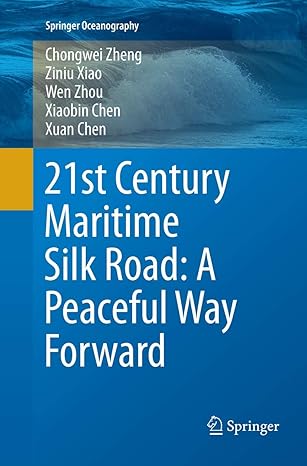
21ST CENTURY MARITIME SILK ROAD — A PEACEFUL WAY FORWARD
| Author(s) | Chongwei Zheng and others. |
| Publisher | Springer |
| Date | 2019 |
| Pages | 191 |
| Format | |
| Size | 39 Mb |
| D O W N L O A D | |
The 21st Century Maritime Silk Road, proposed by Chinese President Xi Jinping, has attracted increasing attention from a broad array of countries and regions. This initiative reflects China’s enduring commitment to peace and development and is posited to promote economic prosperity and regional economic cooperation, enhance intercultural communication, and contribute to global peace and development.
The Maritime Silk Road is expected to inaugurate a new era of global interconnection, cooperative engagement, and mutually beneficial outcomes, underpinned by equality and mutual aid. More than 70% of the Earth’s surface is covered by the oceans, which function not only as regulators of the natural environment but also as pivotal engines of social and economic development. The oceans serve as the cradle of human life and as a repository of resources that may foster China’s national rejuvenation and contribute to the sustainable development of global society. Nevertheless, the initiative entails both challenges and opportunities. The Maritime Silk Road traverses the South China Sea and the northern Indian Ocean, incorporating a large number of states, spanning considerable geographical ranges and long distances.
The complexities arising from the marine environment, limited access to electricity and freshwater resources, diverse political and cultural bases, intricate maritime rights disputes, and persistent geopolitical tensions collectively complicate the construction of the Maritime Silk Road. For instance, storm surges in the Bay of Bengal in 1970 resulted in substantial loss of life. Consequently, a robust understanding of marine environmental characteristics is a prerequisite for the safe and efficient realization of the Maritime Silk Road. However, limited basic research and data scarcity on marine systems presently constrain the full implementation of the initiative and warrant urgent address.
The "Read Later" function allows you to add material to this block with just one click. Just click on the icon and read the articles that interest you at any convenient time.