Types of Sedimentary Rock
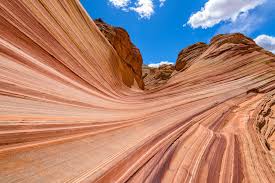
Each depositional environment has its characteristic assemblage of sedimentary rock types. When discussing these types, it is convenient to think in terms of three basic types: clastics, carbonates, and evaporates. Note, however, that any rock is likely to have characteristics of more than one of these types.
Clastics
Clastic sedimentary rocks are composed mostly of particles derived from other rocks. There are two basic types of clastic particles: mineral grains, composed entirely of a single mineral, such as quartz, feldspar, or mica; and lithic grains, which consist of an assemblage of different minerals, like miniature rocks. In rocks with clastic texture, the grains touch each other but do not interlock. The crystalline texture of igneous rock, by contrast, is characterized by mineral grains that are in contact on all surfaces, having formed and grown together as the rock solidified. Sedimentary rock usually has empty (or fluid-filled) spaces between grains.
Clastic rocks are classified primarily by grain size. They are named according to the size of the particles that make up more than 50 percent of their bulk. A rock composed of 60 percent sand and 40 percent calcite, for example, would be called limy sandstone.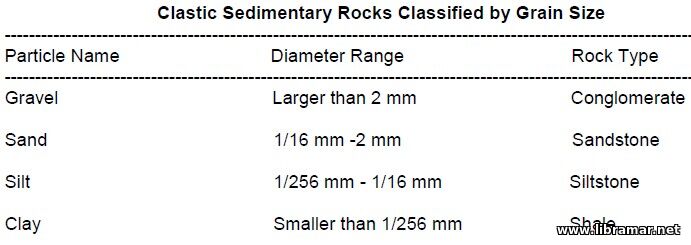
The coarsest rocks, conglomerates, indicate former high-energy environments: steep topography, swift streams, and heavy surf. Some conglomerates are made up of broken, angular particles that have not been rounded and smoothed by transport. These rocks, called breccia, are typical of landslides, volcanic debris, and certain glacial deposits.
About 25% of the world's sedimentary rock is sandstone, composed mostly of particles 1/16- 2 millimeters in diameter. Sandstones vary widely in mineral content, grain shape, sorting, and other characteristics; the cleanest, most uniform, most porous sandstones are those deposited in beach and dune environments. Well-sorted sandstones with round, smooth grains tend to be very porous; about one-third of their bulk may be void space.
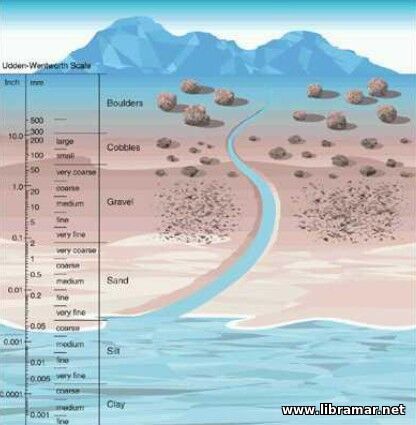 Porosity can be reduced by the infiltration of finer sediments, by cementation, and to a limited extent, by compaction. It can be increased by the leaching out of cement or individual mineral grains or by the removal of fine particles by groundwater. The texture of siltstone is similar to that of sandstone, but the grains of the finest siltstones are too small to be seen by the unaided eye.
Unlike the generally. round grains of sandstone, the flat, microscopic particles of clay that make up a typical shale are both adhesive and cohesive; that is, they cling to one another and to water, making clay both sticky and water-absorbent. The clay particles in a freshly deposited layer have a loose, disorderly arrangement, like a heap of cards. Such a deposit may have a porosity of 90% or more and contain a great deal of water. When deeply buried and compacted, however, clay particles break and line up like bricks in a wall with little void space between. Porosity may be reduced to 10% or less as fluids are squeezed out.
Carbonates
The carbonates, sedimentary rocks that consist mostly of calcium carbonate and magnesium carbonate, are limestone and dolomitic limestone (often called simply dolomite). They are formed by any of several processes or a combination. One of the most important of these is a life process; for this reason, limestone is sometimes classified as an organic rock.
Many marine organisms take calcium from the water and use it to make a shell. When these organisms die, their shells fall to the bottom and accumulate along with mineral grains, typically the clay that is deposited in quiet backwaters, where life is most abundant. The result is lime mud, a calcite-rich sediment that is the starting point for shaly limestone. Limestone often contains an abundance of fossils, especially the shells of calcareous organisms.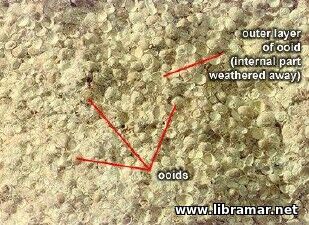
Oolitic limestone is composed largely of the rounded sand like grains of calcite known as ooliths, formed by the accretion of layers of calcium carbonate on smaller particles, like scale in a boiler. A cross section of an oolith reveals an internal structure much like that of a hailstone.
Reef limestone is formed more or less in place from the skeletons or shells of large colonies of marine animals. A coral reef, for instance, is made up of the branching-skeletal remains of large colonies of tropical coral polyps, on which other skeletal debris and shell fragments have accumulated. El Capitan peak in West Texas is a Permian reef that was buried in an epeiric sea and later uplifted and exposed.
The porosity of limestone is little affected by compaction, but depends largely on the type and proportion of other sediments, such as clay or sand, that make up the rock, as well as on the degree to which calcite or other cement fills its pores. New limestone is very porous-as much as 60% to 70% void space. As limestone ages, cementation can reduce porosity to 5 percent or less. Later leaching by aerated groundwater may restore lost porosity by creating solution channels and small caverns called vugs. Leaching by magnesium-rich water can also lead to dolomitization, the replacement of calcium carbonate by magnesium carbonate (dolomite). The porosity of limestone petroleum reservoirs ranges from 5% to 20%, but is usually localized and irregular.
Evaporites
A third type of sedimentary rock is formed from the dissolved minerals left behind when water evaporates. Halite, rock salt, is one of the most common evaporates. Deep beneath the seafloor in the Gulf of Mexico lie thick beds of salt that were deposited millions of years ago when seawater evaporated from an isolated ocean basin. As the basin deepened, clastic sediments were laid down over the salt. The weight of these overlying sediments has deformed the soft, light salt layer, causing it to bulge toward the surface in a series of mushroom like columns. Although the salt is nonporous and thus cannot contain oil or gas, each column pushes overlying porous layers upward in petroleum-trapping domes.


The "Read Later" function allows you to add material to this block with just one click. Just click on the icon and read the articles that interest you at any convenient time.