 The content of this volume is providing readers with a good introduction to the shipping industry covering all important aspects. It shall be treated as a very valuable source of relevant information to be used by the students of maritime shipping law and by the people willing to get a proper understanding of maritime services.
The publication contains the information as well as the analytical content on both international and national shipping practices. This is a new edition of the volume; the previous book represented a general intro to the shipping explaining the maze of shipping regulations and analyzing the main relevant issues.
The present edition, apart from giving a first-rate introduction, is covering several additional aspects of the industry. It covers different sectors of the industry, co-operation issues in liner shipping, maritime governance matters, protectionism and liberalization, private shipping organizations, maritime security and applicable safety standards, limitation of liability and other topics. There are several data tables provided in the appendices to give some additional information on the cases and legislation as well as Conventions and other regulatory documents.
 The term "piracy" is commonly used when we want to describe the armed robbery acts, hijacking plus many other malicious acts all of them are carried out against vessels in international waters. Subject acts are done by the people intenting to steal the valuable assets or to extort the money from the owners of the vessels.
This publication produced in conjunction with IMB, INTERTANKO, INTERCARGO, and SIGTTO consists of the Introduction which is followed by five chapters - Risk Assessment; Preparation; Conduct During Transit of the High Risk Area; Actions on Encountering Pirates; Port Incident Actions and Reporting - and two annexes - Standard Ship's Message Format, and Useful Contacts.
The publication concludes with a list of reference sources of information. The content of the volume will be practical and useful for the shipping industry people with the interest in the contemporary maritime piracy, the dangers encountered by the vessels engaged in trading in the mentioned waters and measures that may be implemented to counteract. As the readers will see, the book covers literally all relevant aspects of the piracy in the east African region.
 The present Vessel Agent’s Handbook addresses all most important aspects for any ship agent taking into account that it describes literally all procedures that shall be followed at the time of the vessel entering the port.
Among the topics that have been covered in the pages of this practical and useful publication there are cargo declaration submission, explosive handling permits, required drills and tests to be conducted prior entering the port, marine casualties and reporting the oil spills, appeal procedures, guidance for populating and checking the content of the International Safety Management certificates, BWM mandatory reporting requirements, ISPS Code examination objectives, required nautical charts and publications, detailed definitions of dangerous cargoes, advance notice of arrival and many others.
The volume is a real must-have one for every practicing ship agent as well as to the persons intending to get engaged in the provision of ship's agency services since they will find absolutely all required information and procedures in a single handbook. The descriptions are very clear and coverage is remarkable eliminating the need for any other publications.
 This UNCTAD study on contemporary maritime piracy consists of two volume. The first volume represents a thorough and comprehensive overview of the ongoing trends, costs and the trade-related implication in the shipping industry of today.
The second part of the set is actually an overview of the modern international legal framework with particular attention paid by the team of authors to the multilateral cooperation in order to successfully combat contemporary maritime piracy - this one was published separately under the UNCTAD/DTL/TLB/2013/3 number.
Both documents contain useful information, necessary clarifications provided by the experts, corresponding maps and all other data officially provided by IMO, ICC and IMB professionals. The volume will be of practical interest to all persons engaged in ship management and operation, ship officers, ship owners and all other people having interest in provision of safety of navigation.
The content of the document is based on the information obtained from the world respected source and definitely deserves close look. Take your time and go through very carefully since safety is the top important aspect of ship handling and operation.
 Today, the natural resources found and expected in the Arctic region have an increasing value for commercial use resulting from economic, social, geopolitical, industrial, technological, and climate-change factors. That is why the XXI century is sometimes called as a "Century of the Arctic".
The abbreviation NSR stands for the "Northern Sea Route" which was a so-called "national transportation route of the Soviet Union," or "historically developed national transport communication line of the Russian Federation" as it is commonly reflected in historical Soviet and now Russian legislation.
This waterway has played a crucial role in opening up the Arctic for transport and commercial opportunities. It's important role for the international maritime shipping industry, trade and economics is is rapidly increasing. It was effected by significant political changes governing its use and information through history.
This is actually evident by contrasting its period of closed access for sailing by the vessels flying foreign flags in the times of the ex-Soviet Union (thereafter USSR) to its opening for international navigation after the eventual collapse of the USSR...
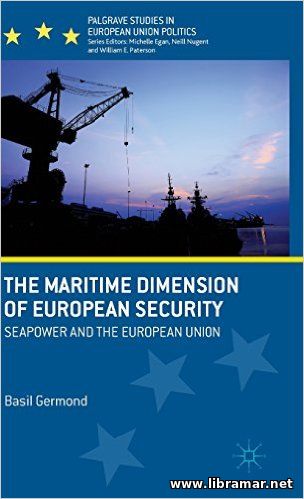 An excellent and very informative title prepared by Dr Basil Germond reading brilliant lectures at the Lancaster University, teaching his students policy and theoretical aspects of the international relations. the author has based his exploration of the European maritime security on the proper geo-strategic and historical understanding of the significance of sea power together with the security demands as well as the relevant EU obligations.
According to the experts, this book is an invaluable contribution to the general understanding of the global sea power realities which is often neglected. The author provides a truly ground-breaking analysis of the subject skillfully combining theoretical and empirical approaches, which eventually resulted in this volume serving as a landmark to put him in the very forefront of the analysis of the modern maritime security.
The title accounts for the ongoing trends in the sea power politics and maritime strategy touching the latest developments at practical and conceptual levels. The readers interested in the subject, will obtain the tools for the critical assessment of the European Union's potential...
 The significant and thorough reconsideration of both tasks and responsibilities by the central governments is considered a real international phenomenon. There is an ongoing trend towards the increased mechanism of the market mechanism - we are talking about deregulation and privatization, and decentralization, including both functional and territorial; subject trend has become accepted worldwide for the past decades under the leadership of several former American and British political leaders, i.e. Reagan and Thatcher, respectively.
Even though the political doctrines were harmonized, the methods used for their of implementation were quite diverse. In America initially the decentralization opportunities that were presented by the so-called "New Federalism" were emphasized where the local government relied once more on its own vitality. In the meantime, the opportunities that were offered by privatization were mainly geared to contracting out. This is the useful document with the information useful to the people with professional interest in the industry.
 The author of this thesis is providing the examination of the heuristic approaches in order to solve the SRSP, standing for the ship routing & scheduling problem. Subject method was originally developed to address the problems associated with loading cargo for the customers using the heterogeneous ships. the constraints are related to the delivery time windows that are commonly set by the customers.
The ultimate aim is the minimization of the overall operation costs keeping all customers satisfied. Two different routing and scheduling types have been considered. The first type is called the single-cargo problem - in this case the ship is loaded with only one cargo, while the second approach implies loading different products for their transportation and delivery to the different customers.
The document opens with the general information about the transportation management and sea transportation, followed by the chapters dealing with the integer programming and approximate techniques, providing the a good overview of transportation research, exact approach design, model variation, specification and algorithms applied to the ship scheduling, and many other aspects of the problem.
« 1 2 ... 9 10 11 12 13 ... 15 16 » |