 The present book of selected electronic projects is representing some of the best projects that appeared in the popular "73 Magazine". In this single volume the electronics experimenters will find various interesting projects - note that it will be also interesting to the radio enthusiasts and, in fact, literally anyone having an interest in electronics.
The projects included in this publication are covering all fields of electronics - from receivers to transmitters and from power supplies to testing equipment. The readers will even be able to construct some of the equipment themselves, just following the detailed instructions provided in the book. The authors have even included several simple projects for the beginners. The original intention of the authors was to provide all enthusiasts of electronics with a good compilation of tried, tested and proven electronics projects.
Five major chapters of the publication address power suppliers and power regulators, general testing equipment, special testing equipment, amplifiers, and receivers. Definitely recommended volume to anyone making his first steps in the amazing world of electronics, since it is really dealing with all important areas of electronics - it means that the readers will be given a good chance to apply their theoretical knowledge and may try to do something real.
 It is easy to say that this new book is for anyone involved with S7-300/S7-400 and SIMATIC NET networks, but in fact, this is the case. If you are a controls engineer, responsible for design and programming, a maintenance technician, an applications engineer, or sales representative, you'll find that this book provides much useful information.
The book offers significant coverage of configuration concepts, addressing memory and I/O. programming in STEP 7, defining network configurations, as well as a guide to using the tools for monitoring the program, and diagnosing problems in the hardware, software, or in the process. If you are a controls or applications engineer, your work will likely involve both configuring the hardware and programming for S7-300/S7-400 and SIMATIC networks.
You'll find examples ot the most typical configurations, as well as an explanation for various module parameters. In most cases, you'll find that the default parameters are generally usable, but you will learn how to obtain different operational behavior in the CPU and other modules. The Chapter on Working with STEP 7 Programs and Data is a great reference for learning about program design, data types and formats, instruction sets, and how to write code for Functions (FCs) and Function Blocks (FBs). You'll also learn the basics for structuring a program and calling blocks.
 This volume surveys the latest technologies that are used to satisfy the world's need for the cleanest and most efficient electricity and provides a good and thorough examination of the synchronous generators used for various applications. It offers readers a very focused treatment to the modeling and design, control of the performance and testing of the grid-connected and stand-alone generators being operated synchronously.
The publication gives a nice intro to the electrical energy and it's generation, and covers the basic principles of the operation of electric generators. Separate chapter has been devoted to the most popular models of the prime movers for the transients that are used for the active control of generators, while individual chapters of the book explore the various aspects of the large and medium-power generators.
There are many sample results, examples and illustrations highlighting the concept. The book will supply it's readers with all tools that are required to design the right power generation technologies, validate and deploy them, and to fulfill the very complex energy requirements of tomorrow. An excellent book on the topic and perfect reference source for anyone involved in design, construction, operation, maintenance and/or repair of the generators.
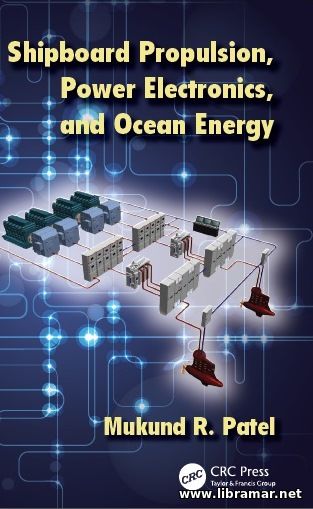 This handbook is intended to cover all modern technologies related to the propulsion of the vessels and power electronics as well as ocean energy. The material in question has been studied with the depth and breadth that the reader will hardly find in any other publication of same kind. The author has made a good attempt to examine the power electronic systems utilized for vessel propulsion as well as for extracting the energy of the ocean, which shall be treated as the mirror images.
The publication comprises of sixteen chapters divided into four major parts, namely power electronics and motor drives, in which the author explains the very basic converters and drives, cooling methods and power quality, electric propulsion technologies, mainly focusing on the ships propulsion by means of the superconducting motors and other latest technologies, renewable ocean energy, exploring the energy coming from the ocean waves and currents as well as from the wind farms installed offshore, and, finally, system integration aspects, where the author is discussing the energy storage and system reliability factors, essential for any of the power systems.
This is a really ideal textbook that may be used even in marine academies with engineering programs. It will be equally useful to marine engineers, ship constructors and all other specialists.
 The present book begins with the very brief intro to the basics of the semiconductor technology, including their structure, band theory of crystals and description of the energy level diagram. Difference between extrinsic and intrinsic semiconductors is explained in this opening chapter, and types (N- and P-) of the extrinsic ones have also been covered together with some other information.
The next chapter has been dedicated to the semiconductor junction diodes while the third one addresses the diode circuits and provides the necessary information about clippers, clampers, rectifiers, comparators, filter circuits, voltage multiplying circuits etc. Then there comes a chapters dealing with the transistors, integrated circuits, and their fabrications.
The rest of the titles include transistor biaising techniques, two-port network theory and circuit models, small signal basic amplifiers, multistage and feedback amplifiers, power, tuned and wideband amplifiers, oscillators, multi-vibrators, basic logic gates, and other information. Definitely needful publication for the electricians and all people dealing with the design, maintenance and repair of the electrical equipment and systems.
 Here is the 2nd thoroughly updated edition of the world famous "The Art of Electronics" book, which has been revised in order to include all latest developments of the electronics world. The present publication is worldwide accepted as very successful reference book on the analog/digital electronic circuit design, in fact it revolutionized the whole process of teaching electronics by emphasizing the methods that are currently in use by circuit designers -- a combination of the basic laws and rules of thumb plus huge number of tricks.
The efforts of the authors resulted in largely nonmathematical treatment encouraging circuit intuition as well as brainstorming and simplified calculations of the electrical circuit performance and values. The publication is full of sharp insights and, at the same time, requires minimum knowledge of mathematics. The depth and richness of examples supplementing the theoretical material, is truly genuine.
We would recommend this book to any person involved in the experiments or researches in the field of electronics since it is delightful; note that all schematics are readable and the circuits do work. The publication features a tremendous diversity of invaluable technical info and will provide readers with an easy way to learn everything about the electronic design.
 We are glad to introduce the fifth release of the Programmable Logic Controllers which continues to be very easy-to-use book, providing readers with the very basic principles of such controllers without tying to any particular manufacturer of PLC.
The present volume contains a truly extensive number of various examples and solved problems intended to assist in better and more thorough understanding of the theory provided, and utilizes various popular controllers, trying to highlight the fundamental knowledge to be used without having to address any of the PLC manufacturers. The publication is intended to help the readers to understand the basic principles of the design and internal architecture, principles of operation of the controllers and to identify the associated safety issues as well as fault diagnostics methods, ways of proper testing and debugging.
Numerous case studies have been included in this edition of the book to supplement the theory; the title also features the extended coverage of the sequences, and much more details have been provided there relating to the programming using the sequential function charts, testing inputs and outputs, comparison of various relay-controlled systems etc.; the IEC programming standard has also been touched in this publication together with the programming devices, security issues etc.
 The present publication was written by John Winders on the basis of the training materials of the Transformer Applications course. It aims to cover the most relevant and important topics, like basic theory of the transformers, two-winding transformer connections, transformer impedance/losses and three-winding transformers, automatic transformers, short circuits, inrush currents, auxiliary electrical equipment, reading and applying name plate data, and, finally, maintenance, troubleshooting and testing, as well as their reliability.
The theoretical materials that are provided by the author are supplemented with lots of equations, data tables and illustration for their easier understanding. The author has covered the underlying theory of the power transformers and also touched the issues relating to the application of this theoretical knowledge to the design process of the transformers. This handbook would also be very helpful when used as a sort of practical reference for the industrial power engineers.
In addition to all the summaries provided in each of the chapters, the main body of the publication gives a truly excellent descriptions of the various auxiliary electrical equipment and systems. In short, the book gives the info on how to read and interpret, and subsequently apply the data on the transformer's nameplate...
« 1 2 ... 9 10 11 12 13 ... 15 16 » |