 Nowadays, the role of a marine engineer working on board a ship requires deep technical knowledge of various relevant engineering disciplines and their application. In addition, nearly every single piece of the shipboard equipment is fed and/or controlled by electrical power. The present publication is intended to serve as a good textbook for marine engineering students and electro technical officers.
However, it may also be used for self-study and included in libraries both ashore and onboard vessels as a very good reference source. The book consists of twenty-six chapters written in quite simple and easily understandable English. The author not only explains the fundamentals but he also deals with the operating principles, procedures for proper maintenance, design and construction features, and rules/regulations governing the safe and efficient operation of all shipboard electrical systems.
There are also some extracts from class societies' rules. There is also a Teaching Guide provided at the very beginning of the volume, and it suggest a standard methodology of teaching. Moreover, there is a questions bank covering all topics explained in the main body of the book to check and control the progress, hundreds of figures, images and other valuable supplementary information for better understanding.
 Since the day of the original publication of this book, its author, Keith Bridley, has added lot of new materials in order to make sure that the publication is relevant and up-to-date. We hope that all readers will agree that the practical nature of this publication lends itself to a self-learning experience that all readers could easily follow in a logical and manageable manner.
Here are the main chapters - it starts with the chapters describing the very first steps, followed by the one dedicated to the measuring electric current and voltage, capacitors and ICs, filters and oscillators, diodes and transistors, analogue/digital integrated circuits. The comprehensive Glossary of terms is provided at the end of the book. The publication is based on the collection of the articles previously published in professional magazines and chosen not only because of their popularity among readers but rather because of their relevance to the introductory electronics. Most of the people when looking at electronic diagram have no idea what it is.
For such beginners, electronics may seem as a black art. However, electronics is just another field of science and you only need to be aware of the rules to know what is happening. It is a very interesting and practical science, and this book will help you understand the very basics of this amazing science.
 The book embraces a huge number of applications of modern math and teaches both continuous and discrete systems particularly vital for DSP; moreover, since the engineers of today are required to be in line with the software, applicable information has been integrated in the present publication.
The author of the textbook did her best when trying to avoid going into too excessive technical details and using specific language. The emphasis in the book has rather been made to an application of the basic concepts behind the math, for solving the problems and undertaking the critical analysis of the obtained results. The text of the material has been supplemented with the numerous worked examples and so many exercises were included to ensure that all math theory is really relevant to the real world engineering.
In addition to all that has been stated above, it shall of course be noted that this publication includes a comprehensive introduction to some of the advanced topics like Fourier analysis and random processes/vector calculations. We would say that this publication shall definitely be considered a must-have book for anyone dealing with such calculations since it is truly comprehensive textbook that would provide them with desired technical information on calculations.
 Here is the fourth, updated and revised, edition of the Basic Electrical Engineering. The book has been prepared with the specific intention of the authors to make a book that would serve as a good training course for virtually all engineering students of electronics, computer and mechanical engineering, communications, etc.
With the very latest technological advancement in nearly all spheres of engineering, it is becoming too difficult to provide users with more than one slot for inter-disciplinary courses. However, the author of this publication feels that no engineering could work without electric energy, which is true. We all know that the basic input to all engineering is the electric energy, and that is why a basic course on Electrical Engineering theory is one of the essential studies for all engineering students.
The opening chapter of the publication has been dedicated to the direct current circuits; it is followed by the chapter on the electromagnetic induction. The other chapters of the publication cover the alternate current circuits, network theory, three-phase supply, address some basic instruments, describe the theory, construction and operation of the transformers and DC machines, shed some light on the three-phase synchronous machines and induction motors, power systems, domestic wiring etc. There are numerous multiple choice questions provided in the closing chapter of the book to check your knowledge.
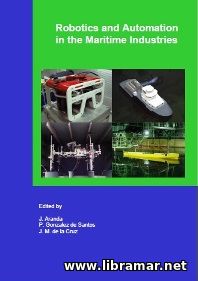 This publication was prepared by three recognized experts in this field with the main of the declared objectives to disseminate the accumulated technical knowledge together with the applications of the Spanish working groups dealing with the scientific technical researches in the relevant fields of maritime robotics/automation. There are some serious discerning between control and guidance, when applied to the marine vehicles.
The term "guidance" usually corresponds to the determination of the factors as the attitude, course and speed of the marine vehicle, relative to the established reference frame, e.g. earth, that is to be followed by the above mentioned vehicle. The term "control" would rather be corresponding to the development plus the application to marine vehicles of the various forces/moments for operating point controls, stabilization/tracking, and this all would definitely involve the feedback/feedforward control laws.
This volume contains fourteen chapters covering all control problems in marine vehicles, interactive software tools, long disturbances compensation techniques, reactive control of a visually guided UCT (standing for the underwater cable tracker), underwater climbing robots and impact systems that are commonly utilized for ship hull cleaning, simulation of the sea trials and many other important, innovative and very interesting topics...
 Here are the declared training objectives of the present course - to identify and further explain to the students how to make proper differentiation between the open-loop and close-loop positioning and also to explain the working principle of every technique; the students will get to know how stepper and servo motor control systems achieve the required precision and get familiarized with the general principles of operation of the motors; upon completion of the lesson, the students should be able to properly identify and explain to others how the major components of a direct and/or alternate current servo motor and of stepper motor controller function, explain the most common fault indications, properly describe the conditions in the above mentioned systems that may possibly lead to the operating problems, implement and recommend the operational procedures for prevention of the occurring or recurring of such problems.
We would definitely recommend this publication for training purposes as well as for the refreshment of the basic theoretical knowledge on the subject matters. This study guide was developed and released by Tel-A-Trains and belongs to the Solid State Motor Controls Training series.
 This comprehensive reference source was prepared to provide all interested parties, including designers, R & D engineers and researchers with all required technical information on various alternate current motor system drives. It would also appeal to the students in the field of electrical and power systems, robotics, mechanical engineering, and others.
The book covers all latest advancements concerning the control theory and draws on them to apply a truly wide range of control design methods to a variety of alternate current motors. The publication contains contributions from 30+ top industry researchers explaining how the above mentioned control methods might be used to achieve optimal energy efficiency, safety and operational reliability. The author describes the complete control approach and demonstrates both observer and controller designs by the advanced non-linear methods.
Among the other features of this nice publication there is the good coverage of the main types of alternate current motors, illustration of the use of the advanced control methods with special focus made on non-linear controllers and observers, fault detection/isolation algorithms, etc. The AC control is very complex but this book will provide all required information to make the understanding a bit easier.
 The persons who decide to take the present learning program and satisfactorily complete it, should be able to properly identify and subsequently explain to others the principles of operation of various types of the direct current motors, understand how a solid state direct current controllers regulate the motor speed, get duly familiarized with the very basic operating principles of a DC choppers and phase controlled rectifier bridges, understand and be able to correctly explain different ways of achieving the braking in a solid state direct current control systems, and to properly describe the conditions in such control systems that could possibly result in the operating problems.
Upon satisfactory completion of this module, the specialist must be able to recommend the procedures to avoid such problems, and implement them. The D/C motor controls consist of two parts, namely a motor itself, converting the electric energy into the mechanical motion, and a controller regulating the electrical energy that is required to operate the motors. The electrical power in this case will be regulated by means of the electronic components capable of producing the precise voltages in order to control the motor speed, it's force and torque, with the required level of accuracy...
« 1 2 ... 6 7 8 9 10 ... 15 16 » |