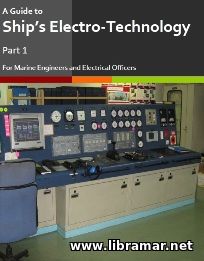
 An excellent guide to the electrical technology on board ships released by the MarineInsight team. Any vessel is like a floating city enjoying nearly all privileges that are commonly available to any of those operational set-ups ashore. Like any city, the vessel requires some fundamental amenities in order to sustain life on boars, and the most important of the amenities would be electrical power, which is generated by shipboard generator or alternator working together.
The material in this booklet is arranged in four sections. The first section provides the general information on power generation, shipboard HV systems and electrical propulsion of vessels. The second section of the book is devoted to the electrical instruments including PMMC and Megger, thermocouples, rectifiers and amplifiers together with the associated circuits.
The next section addresses electrical safety on board ship, covering safety devices fitted on the main switchboard, electrical fires and insulation, safety and precautions, generator safety matters and blackouts. The closing section of the volume is dealing with the electrical maintenance including electrical faults, relay maintenance, motor overhaul, maintenance of bus bars and alternators, and routine inspection of electrical starter panel.
 One of the most classic books on electrical engineering. First released more than a century ago, the book still remains one of the best available resources providing clear explanations of the theoretical fundamentals making them easily understandable to anyone.
The lectures contained in the book are quite general, and deal with the most important problems of electrical engineering including generation of electrical energy and its control, transmission of energy, its distribution and utilization. It means that the readers will find all required information about the related to the electrical systems and their components, operation of such systems and apparatus under all different conditions covering design of the electrical systems as well.
Note, however, that the design of the electrical apparatus has been discussed only to the extent necessary to get proper understanding of their operation and make further judgment on their application. The treatment of the subject in this book is mainly descriptive not mathematical; it contains the discussion of various applications of the electricity, apparatus and means, and methods of application together with the advantages and disadvantages of different methods determining the choice of particular method and apparatus...
 The subject of the present textbook is control of marine vessels. By marine vessels we hereby mean conventional ships, HSC, submarines, semi-submersible offshore structures, floating offshore drilling rigs and other offshore installations, underwater vehicles being remotely or even autonomously operated and any other powered/propelled vehicles.
We all know that a marine vessel during maneuvering experiences motion in six degrees of freedom. The feedback control systems and their application to the ships are becoming more and more popular due to the recent developments kin computer science, ship propulsion systems and sensor technology.
There are many systems commercially available today, such as the auto-pilots for ships and UV used for coursekeeping/turning control, way-point tracking systems, torpedo control systems, depth auto-pilots and attitude control systems used on the underwater vehicles, dynamic positioning (DP) and positioning mooring (PM) systems on marine vessels and floating structures, path control/trajectory control systems, buoyancy, propulsion, power management and energy control systems, heel/trim correction systems, wave-induced vibration damping systems used on HSC, roll stabilization systems and others...
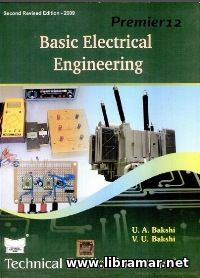 The book starts with the very fundamentals of the electricity - subject chapter explains the structure of matter and concept of charge, current and electromotive force, charge-current relation, electric resistance, conductivity and resistivity, how temperature affects resistance, insulation resistance, batteries and cells, cell types and terminology involved.
The second chapter deals with the direct current circuits - terminology, their classification, sources of energy, voltage and current division, combination of sources, fundamental laws, source transformation, basic rules, theorems, and concepts. The next chapter addresses magnetic circuits - magnets and their properties, magnetic field, fundamental laws, pole strength, magnetic flux, permeability, reluctance, comparison of electric and magnetic circuits, etc.
Then there comes a chapter dedicated to the electromagnetic induction - the readers will know about Faraday's experiment and his laws of induction, nature of the induced EMF, dynamically-, statically-, self-induced and mutually induced electromagnetic force, energy that is being stored in the magnetic field, etc.
The contents of the book is huge so we will just say in short that the other chapters cover electrostatics, alternate current fundamentals, single-phase and poly-phase A/C circuits, single-phase transformers and so much more useful info.
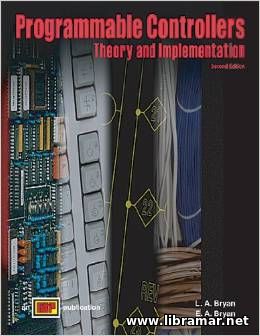 The capabilities of the PLCs have significantly grown from the time when the first edition of this book was released. Same applies to the applications of the programmable logic controllers. Nowadays, it would be next to impossible to find the industry where the PLC would not be utilized in one form or another. This edition of the publication provides a good practical and theoretical look at nearly all important aspects of programmable controllers, their devices and associated systems.
There are some new chapters included in this edition, e.g. ones touching the input/output bus networks, process control, fuzzy logic etc. this release presents the thoroughly revised and updated information on the existing topics and such info is supplemented with graphics and hands-on examples for better understanding and illustration. The new layout has been implemented by the authors.
In addition, there is a Glossary at the end of the book explaining the terminology and abbreviations used throughout this publication and in the electrical engineering, in general. We definitely hope that the readers will find this book very useful for learning and will use it as a reference tool, taking into account the number of covered topics and way the material has been presented.
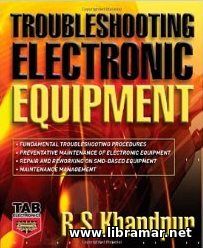 The readers may and shall use this book to find the easy-to-follow step-by-step procedures for correct identification of the causes of most of the problems occurring in the electronic equipment and methods of repair. Any sort of equipment, from digital electrical circuits to multi-meters - this is a good practical guide covering nearly every piece of equipment and providing the required techniques of troubleshooting and preventive maintenance of any such equipment.
The text part of the main body of the publication has been supplemented with more than three hundred detailed illustrations and huge number of in-depth examples for better understanding. This book also features a wealth of effective aids and tools for servicing of the electrical equipment, complete coverage of all electrical circuits together with their components that are usually utilized in small or large electronic equipment all around the globe, necessary guidance for reworking and repairing, as applicable, of the SMD-based electrical equipment, and provides expert advice on proper troubleshooting of any microprocessor-bases electrical equipment.
It also provides all required tools and techniques for correct troubleshooting of any problem that may happen to the electronic equipment that is why it's usefulness simply cannot be overestimated...
 The publication includes description of all basic types of electrical relays and explains in detail their operation principles as well as applications. The scope of the present publication is quite broad and, in fact, unique, in the sense that in this book the author represents the very first illustrated encyclopedia of the electrical relays.
The book also includes some kind of historical background f the design of so many different types of electrical relays, which is not always familiar even to the specialists in this field; in addition to that, particular attention has been paid by the author to this issue taking into account the need for a display of expertise on the present subject.
All major issues that are related to the design and operated principles of the components of the relatively complicated types of the relays have been discussed in this book, too, and this will definitely allow readers to understand the operation principles of such relays better and without the necessity of referring to any additional source of information. The book has been written in a very clear and understandable language, without any math treatment, and includes a huge number of illustrations making it easy-to-use for a wide range of engineers not only to electrical specialists...
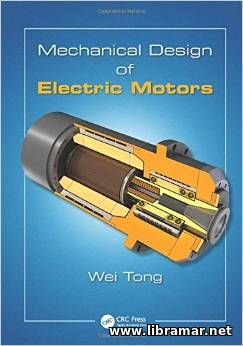 The recent significant increase in the consumption of electrical energy and the strong emphasis being made on the environmental protection have caused the challenges for the electric motor industry. The present volume has been specifically prepared to suit the motor manufacturers and designers, engineers and personnel involved in the periodical maintenance and/or repair of the motors, students and researchers, and to provide all required technical knowledge on the various design methods and latest developments concerning electrical motors.
The author has mostly focused on the mechanical design issues and detailed the manufacture and design of the key components and subsystems, e.g. shafts, frames, stators and rotors, reviewed the different motor cooling techniques, discussed the calculation and analysis of the power losses occurring in electric motors, addresses the acoustic noise and motor vibration issues, presented various interesting methods of engineering analysis methods supplemented with the numerous informative and illustrative case studies, and also emphasized the construction of the electric motors, their optimization matters and possible applications. The author has shared his great personal experience with the readers so this book will be very useful not only from the theoretical viewpoint.
« 1 2 ... 4 5 6 7 8 ... 15 16 » |