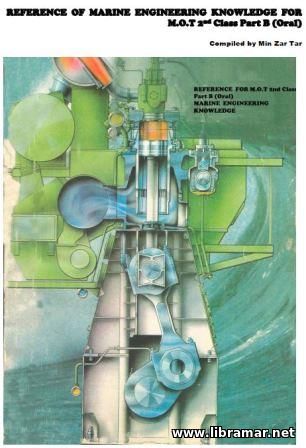
 As the title of this publication implies, it is intended to provide students with the information useful when preparing for the exams. The volume will give reference marine engineering technical knowledge as required for the M.O.T. The material compiled and carefully selected by the author, has been arranged in the thirty five sections.
The first several sections are devoted to the indicating diagrams and purifiers, compressors and boilers, lube oil, heat exchangers, air conditioning systems, and bearings. Then, the students will start to read about the shipboard steering gear arrangements and electrical installations, pumping devices and fixed/portable firefighting arrangements and systems, supercharging, scavenging etc. Some essential information on the naval architecture has been provided in a separate section.
Note that the pollution of the marine environment has also been covered since it is one of the areas paid attention during the examinations. The rest of the sections are dealing with such important aspects of marine engineering as the propulsion and auxiliary diesel engine components, their construction and working principles, shafting arrangements, valves, lines, piping, and, of course, survey and inspection requirements.
 We are hereby offering the latest and popular English edition of maybe the most popular handbooks of diesel engines providing remarkably comprehensive overview of every type and size of subject engines, from the smallest single cylinder diesel engines and up through the huge two stroke diesel engines installed on board marine vessels.
The material presented in the book is mainly based on the valuable contributions made by almost sixty world recognized industry experts collaborating together. Moreover, in addition to the theoretical fundamentals, this publication treats in detail the critically important subjects of the atmospheric emission, energy efficiency matters, injection systems and exhaust gas after treatment, electronic engine control and management, as well as the conventional and newly introduced alternative fuels.
This handbook would actually serve as a truly indispensable companion to the study of both theoretical and practical issues of the diesel engines. We believe that it would be equally required to the industry professionals, as well as to the students of engineering (including marine engineering) and in fact everyone interested in learning a bit more about the technology of the diesel engines, their working principles, understanding their functions, interaction of various systems within the engine and other related aspects.
 The authors of this interesting monograph have mainly focused on the dynamical research of the crank-piston mechanisms and were considering both basic and additional motions, They have tried to perform the full dynamical analysis of the piston machinery together with their mechanisms, and that is why the present publication is studying the mechanisms mentioned above, with clearances in the kinematic pairs.
The tasks in question are carried out, making the main emphasis on the frictions in the mechanisms as well as wear and mechanical impacts; moreover, the fracture formation taking place in the links has also been addressed. In addition, the authors of the monograph have paid particular attention to the elasticity of the details of the mechanisms. The publication would be mainly meant for the specialists in the field of the design of the mechanisms.
However, it shall definitely be noted that it will be also useful for the manufacturers of the above stated machinery as well as for the students of the relevant disciplines. It comprises the researches conducted by the authors and published in the numerous popular works. Have a look in this volume if you are interested in the design considerations of the subject mechanisms, you will definitely find a lot of useful relevant information.
 One of the main declared purposes of Gregory Nellis and Sanford Klein, who formed the duet of authors of the volume presented to your attention, was to write a single book that would be able to provide all practicing engineers and all other interested people with the required capability and good practical tools enabling readers to effectively solve various real-world problems relating to the heat transfer, and to do that with the considerable level of confidence.
This publication comprises numerous technically advanced topics. The numerical and analytical methods of problem solution that have been included into this volume are actually being applied to the topics that are not actually considered in the majority of other textbooks. The authors have done their best trying to maximally improve the reader-friendliness of this book and, in order to facilitate this feature, they have presented completely the derivations of the most important results, with no skipping any steps - such the approach would help to reduce the frustration of the students and also improve the retention.
The examples that have been selected for inclusion in this textbook are all quite ubiquitous and inherently interesting for both students and professional engineers. The volume is integrating the popular computational software packs directly with the materials on heat transfer...
 While the publication was originally written with the automotive industry in mind, the content will also be useful to the engineers engaged in the marine industry. The introduction is followed with the first chapter dealing with the engine supervision methods, troubleshooting and fault finding, and different methods that are used for diagnosis and belong to the general field of condition monitoring of the technical process.
The idea is to give a correct indication of any undesired states requiring action in order to avoid any accidents or damages. The second chapter is entirely devoted to the diagnosis works on the internal combustion engines, while the third one is dealing with the electric drives, actuators and motors. The fourth chapter addresses the fault-tolerant systems together with their basic components.
Finally, the appendix to the main part of the publication contains additional information about the models and functions, properties for the systems, as well as the associated states and signals. The publication will be of practical use for the people involved in the technical maintenance and repair of the internal combustion engines as part of their duties.
 The present volume was released to provide some introduction to the essential approaches and basic technical principles of the nuclear power design as applied to the maritime industry, covering such important areas as the design of the reactors together with the associated cooling systems, safety features and arrangements, and many other critical aspects.
The author of the book has provided a comprehensive and thorough review of the fundamental theory of the nuclear-powered facilities, with the due attention paid to the recent advances in the field.in fact, the entire lifespan has been dealt with, starting from the design stage and up to the decommissioning of the equipment after the successful operation period.
In addition, the author has explored the different conditions such as the situation where you do not possess enough room for the deployment of the equipment, the conditions tending to change rapidly, etc. the readers are provided with the extensive info making this title a truly valuable reference source for both industry professionals and graduate students who will all benefit from the content. Particularly recommended to the marine engineers interested in the prospective technological solutions related to the ship powering.
 The pumps, including centrifugal type pumps, and their systems are widely presented in ship hull systems. What it actually means is that every single industry professional dealing with the pump design must possess a very good theoretical knowledge and fully understanding of their working principles. But note that is not enough, and they shall also be familiar with all practical applications of pumps together with the main engineering correlations for flow phenomena.
This volume is mainly intended to be used by pump designers and ship crew members involved in day-to-day operation/maintenance of various pumping arrangements. The chapters of this publication cover such interesting and important topics as various pump types and their performance data, fluid dynamic principles, physical concepts and pump hydraulics, various performance characteristics, part-load operation, cavitation and suction capability, design of the various hydraulic components, issues connected with the vibration and noise, hydraulic forces, pump operation, general characteristics of turbine operation, selection of materials exposed to high flow velocities, medium influence, selection of pump and associated quality considerations, and pump testing. Definitely useful publication for the crew members as well as people willing to get some basic knowledge of pumping technology and systems.
 One of the main intentions that were declared by the authors of the present volume was to work out a book that could serve as a valuable contribution to the ongoing development in the field of transmitting power and possible applications of the power transmission. It was aimed to all people having regular technical dealings with subject machinery, starting from students and to the professional engineers.
The book starts with some quite basic introductory info, which is then followed by several informative chapters dealing with the dynamics of solids, material strength and stresses involved, mechanical gears together with their geometry and measuring, associated calculations, shafts, fits that are there between the shaft and the hub, bearings, lubrication process and lubricants, housings, various standard gear units, noise and vibration, thermal power, the fabrication process, various technical applications, hydraulic motors, variators, applicable ISO standard and definitions/standards that usually apply to the electric machines, electric DC machine and their control, converters, three-phase AC electric machines and associated signal flow graphs, synchronous machines, inverter drives, means of control of rotating field electric machines - basic technical considerations, permanent magnet machines, outline of TQM, i.e. Total Quality Management, the QC (Quality Control) viewpoint, QA (Quality Assurance), main QC (Quality Control) activities and other very important and relevant topics.
« 1 2 3 4 5 6 ... 19 20 » |