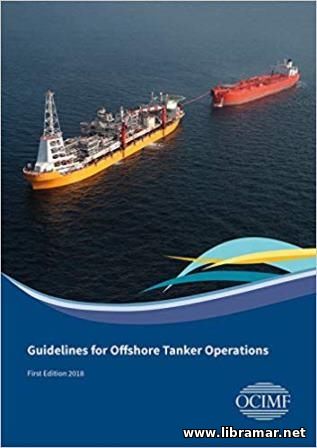
 This is one of the most important and fundamental publications for the offshore industry. The ultimate intention of the authors of this volume released by OCIMF was promoting the harmonization and compatibility between the offtake tankers and offshore terminals, which should be achieved by providing required professional guidance on the established procedures and equipment involved for the mooring operations as well as the cargo transfer operations including transfer of both crude oil and different products.
The information contained in this guidebook is expected to present real life practical interest to the technical operators of the tankers and terminals, tanker- and terminal-based personnel, regulatory officials and all other people involved. The authors have paid particular attention to the safe management of the above mentioned interface.
Eleven sections of the volume cover all applicable industry standards and codes, mooring configuration and equipment at the terminals, station keeping and safe transfer of personnel, risk management, conventional tanker activities, emergency and contingency planning, and other critical aspects of offshore operations. There are several appendices providing supplementary information, and a good glossary of terms. The publication is an absolute must-have to any person engaged in offshore tanker operations in any way.
 This publication was written by two prominent experts in the field of meteorology. Their joint efforts have eventually resulted in the perfect book giving readers the very latest information about the climate and weather as well as the earth science so that they can get introduced to the main theoretical concepts and all current issues.
This eleventh edition of the volume provides very clear and easy-to-understand explanations enabling students to get better understanding of how the information should be observed, calculated and synthesized. All weather phenomena including but not limited to the hurricanes and tornadoes have been discussed in detail.
The authors paid due attention to such important matters as precipitation and winds, seasons etc. It goes without saying that both professional and future mariners should all understand the importance of having a clear picture with regard to the meteorological matters since this normally plays one of the key roles in providing the safety of navigation of any vessel, and therefore we do recommend all people planning to work at sea, to go through the content of this book and get themselves duly familiarized at least with the basics of meteorology.
 This is quite compact but very comprehensive and practically useful booklet prepared by the professional mariner. The original idea and intention of the author was to provide the newcomers to the maritime world with a sort of textbook covering the most important aspects of marine meteorology. The information included by him in the book will be of great use for the navigators when applied during their day to day work and operations at sea.
The main content of the publication has been arranged in six separate chapters. The first chapter is dealing with the stability of air while in the second chapter the author concentrates on the winds and the GCS, i.e. the global circulation system. The next three chapters address depressions and local winds, and provide introduction and useful notes on the ship’s weather reporting.
The closing chapter of the document deals with the weather routing. It is needless to say that this book will definitely help the mariners due to its compactness and clarity of the descriptions that made this volume very popular. Have a copy on your bookshelf or at your computer available at all times should there be any need to have a look and check something important.
 To all people working on board sea-going vessel, including passengers, the approach of their vessel to a shore and arrival of the vessel at the pilot boarding point of the destination port is an important occasion - when you see a pilot boat and pilot himself climbing on board it surely means that your long trip is coming to an end. However, for the pilot reaching the vessel can be quite challenging task.
The present publication was released by The Nautical institute with the ultimate intention of the author to provide readers, including crew members, with all necessary information about the relevant safety aspects. Starting with a brief introduction, the content of the guide moves to protective clothing and established safe working practices that shall be followed on pilot boards. The pilot boat deck safety is dealt with in a separate chapter.
The other chapters address the pilot transfer and pilot ladder safety campaign concentrating on the proper transfer arrangements and their condition, reporting, training, and data banks. The annexes give additional information about the code of practice for boarding and landing, recommendations of the equipment and closing, and first aid treatment in case of carrying dangerous goods.
 This publication has been officially released by the Bureau of Meteorology and this is the fifth edition of the Notes. The content of the book is arranged in ten chapters. The first chapter describes the main objectives of the course, and is followed by the second chapter concentrating on the weather measuring instruments.
The third chapter is devoted to the high-pressure and low-pressure systems and fronts. The following three chapters are covering the weather map, wind and weather services. The remaining chapters of the publication are dealing with the waves and ocean currents, severe weather conditions, atmospheric moisture and clouds.
In addition to that, the book also includes six appendices providing useful supplementary information including terminology used in the weather forecasts and associated observations, list of the web resources, glossary of terms used, and self-test questions coming with the answers for tracking your learning progress.
The publication will present practical interest to the persons whose work activities are directly or indirectly affected by the weather conditions and mariners are definitely falling into this category of people.
 Here is one of the most popular textbooks on marine meteorology. You should tackle the subject of marine meteorology and you will find it very interesting. Pay attention to the order in which you are going to study the topics. You will then see everything falling into a correct pattern. Note that, being a vast subject, meteorology has been addressed in so may publications.
However, the author of the present volume has done his best to provide interested readers with the required knowledge in a remarkably concise and simple to understand manner, enabling them to become duly competent in the subject with considerably less effort. The text part of the publication is supplemented with numerous maps and sketches personally drawn by the author - all of them have been simplified to some extent in order to make the associated topic easy to follow.
This is the third edition of the volume. Some minor improvements have been effected to the content of the previous release relating to the weather codes and reporting system, various meteorological instruments, weather routeing and other important topics. A needful publication for the mariners and students of navigation; it will also be interesting to marine scientists and anyone from the marine industry.
 The present publication was prepared by the specialists of the Ship Handling Research & Training Centre in Poland. As it is stated in the title, the content of the book will guide the navigators of the large vessels as well as of the vessels having non-conventional maneuvering characteristics. The volume opens with the section explaining the maneuvering characteristics of different vessels while the second section is dealing with the control devices.
The third section addresses the effect the restricted water has on the maneuverability of the ship, while the fourth section is devoted to the canal navigation including overtaking and passing. The effect of wind and current has been dealt with in the fifth section. Three remaining sections of the publication will provide information abut the handling of the twin-screw vessels, stopping ships and maneuvering in tide and current and in confined waters.
There are also thee attachments to the main body of this volume - you will find the wheelhouse poster, the pilot card and several charts intended for use for squat estimation. In short, the document will be of significant practical use for the persons engaged in navigating the vessels in question.
 We invite all enthusiasts of the old-time sailing to have a look into this publication. This is a volume about the handling of the square-rigged ships, a truly magnificent ships seeming alive to the people, having no engine and depending solely on their sails. The book was written by the prominent expert in the field, taking readers around the world through the oceans. The narrative text of the book is absolutely perfect and so gripping.
He shares the real dangers associated with sailing the ocean and tells his readers what the expression to "know the ropes" means. Of course, handling of such vessels is not something that you can learn by reading - you need to do this yourself. But, getting such practice nowadays is a task next to impossible. The author of this book made an excellent attempt to acquaint the interested readers with the basics of sailing giving them a sort of introduction to a huge and complex subject.
According to the author, there are two fundamental skills which any ship master shall possess, namely to duly understand the ship and be able to look after her including all the sails and tackle, gear and rigging, and to sail intelligently, knowing the behavior or the main currents and winds of the ocean. This requires experience and the content of the book will give you something to start from.
« 1 2 ... 5 6 7 8 9 ... 14 15 » |