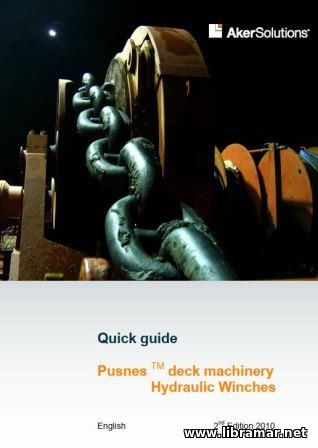
 The main intention of the authors of this publication released by Aker Pusnes was to provide crew members with some guidance to the shipboard deck machinery. Having a good understanding on the arrangement and working principles of the deck machinery will help in preventing the damage of such equipment, commonly caused by the incorrect handling of the mooring winches.
In addition, the guide book has some useful chapters devoted to the preparation of the machinery for use as well as the essential; maintenance requirements. Please note, however, that the present booklet shall not be considered as a substitute to the instruction and/or maintenance manuals provided by the equipment manufacturers and the operators are expected to go through the documents and possess adequate knowledge of their contents.
However, we would definitely recommend this concise volume as a very handy booklet to be available at all times when the additional information and practical tips can be required. Among the topics covered by the authors there are anchoring and mooring operations, inspection of the HPU, standing for the hydraulic power units, anchor and mooring winches, manual operation and others.
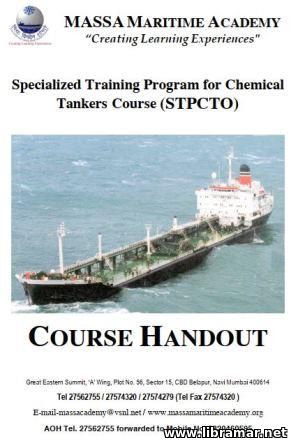 The material presented within this course was mainly intended to give ship Masters and Chief Engineers as well as officers some good training on the chemical tanker operations. It will be useful to all people assigned immediate responsibility for such operations including, but not limited to cargo loading and discharging, cargo handling, and caring of the cargo during transit period etc.
All critically important aspects have been covered, e.g. safety on board chemical tankers, protection of the marine environment, established operational practices and the obligations imposed by the applicable regulatory framework. The publication contains all course handouts and can be used in the classroom as well as for the self-study.
Twelve chapters of the coursebook cover absolutely all aspects of the operations, from chemistry and physics, associated hazards, design of the chemical tankers, and cargo contamination to the cargo handling systems used on board, shipboard safety, pollution prevention, ballasting and de-ballasting operations, ship-shore interface and others. The text is full of supplementary information including glossary of commonly user terminology.
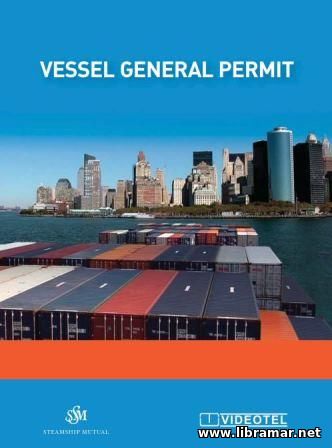 The main declared objective of this training program consisting of the present booklet and supplementing video training lesson, is to provide ship masters and crew members with some essential knowledge of the VGP, i.e. Vessel General Permit. First of all, we will look into what the VGP is at all and why there was a need to introduce it.
Then we will check what VGP means for the ships and what exactly ship crew should do with respect to the established management procedures, inspections, necessary corrective actions, reporting practices, record keeping, and of course training. Particular attention has been paid to the compliance issues and importance has been duly underlined.
The document contains a brief summary of the things to be implemented to reach compliance with the five general requirements of the VGP and twenty-six effluent discharges. It should be noted, however, that this program cannot cover every single element of the VGP and is there for introductory and training purpose only.
The trainees are encouraged to refer to the Final Permit. However, when used together, the training set will make a good contribution to the professional knowledge of those involved in the maritime shipping industry.
 This is another training set for the mariners. Here they will find brilliantly developed instructions on the proper mooring techniques. The training package consists of this booklet and three videos covering the theory of mooring, safe mooring practice, and maintenance of mooring systems. Of course, different ships have different mooring equipment installed on board, but the content of this package provides so-called best practice procedures for the safe mooring that would be applicable to the ships of any type.
Go through the material in the booklet very carefully and watch all three videos, and you will get to the better understanding of the difference between equipment, proper handling of the mooring operations, hazards commonly associated with carrying out mooring tasks etc. Pay particular attention to the case studies.
Effective and safe mooring operations require good understanding of the theory of mooring, starting with the forces that act on the ship and their application to the lines and mooring equipment. All of that information is presented in the booklet and videos in a very understandable format. Note that there are numerous test questions to track the progress of the students, and the assessment answers.
 This is the second part of training set made of three parts, and this particular one addresses the housekeeping matters as applied to the engine room. There are two more parts and they cover the housekeeping on deck and in the accommodation area and galley. In addition, there is a very valuable training booklet with the content supplementing these videos. If you download all videos and a booklet and go through them very carefully, you will get to know everything you need to know about shipboard housekeeping.
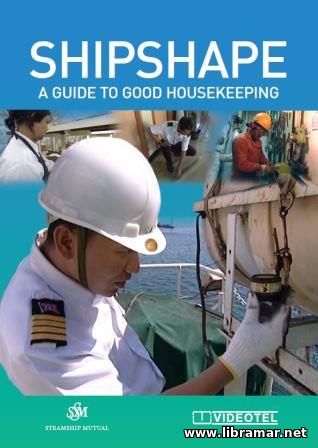 Have a close look into this training package covering the most important aspects of a good shipboard housekeeping. The training set consists of this booklet supplemented with three excellent and very informative videos, addressing the housekeeping on deck, in the engine room, and in the accommodation and galley. The main objective of the authors was to raise the due awareness of the significance of housekeeping and demonstrate how a good housekeeping could be achieved.
The good shipboard procedures for the planned maintenance of any ship will definitely ensure that the structure and equipment of that ship are duly maintained; however, the housekeeping embraces much more areas including timely identification and remediation of the existing deficiencies using the available resources. The ultimate aim is to keep the ship safe and efficiently working at all times.
The housekeeping is a team effort and an integral part of the behavior-based safety, requiring constant safety awareness of all crew members and their vigilance. Their combined efforts will eventually result in operation of the vessel in compliance with the highest standards of seamanship. Though the overall responsibility is with the Master of the ship, every single person on board shall pay close attention to the shipboard housekeeping.
 The watchkeeping both in port and at sea is considered the fundamental duty of any deck officer who normally receive a mandatory training related to the watchkeeping starting from their very first day on board. However, this training shall be supplemented by the learning and valuable advice received from the senior officers. There used to be no text covering the responsibilities and duties of the watchkeeping officers until the relevant resolution was released by IMO.
The IMO guidelines, in turn, were of quite general nature and as such could not be treated as completely covering all required details. The author of the present publication took into consideration the significant role played by the formal education and understood the need for the volume duly specifying all the aspects of the nautical watchkeeping.
The content of this well arranged publication addresses all important topics. The text reflects the huge practical experience of the author. The modern seamanship is one of the areas where the changes happen very frequently, this would include different vessels and people of different nationalities working on them, different shipboard equipment and applicable legislation etc.
 Another piece of classics here offered to the attention of pour visitors. This is one of the most popular books on marine navigation and nautical astronomy of the past times. The theoretical information and knowledge provided in the pages of this brilliant publication remains useful and easy to understand even though the volume was published in the nineteenth century. Moreover, this is a must have one for any collector of the marine books.
There are ten chapters in this book. The first three chapters cover the general topics related to the sailings, traverse, parallel, refraction and time, including equation of time, sea time, astronomical time, civil time, standard time etc. Then, the three chapters come there dealing with the Nautical Almanac, the Astronomical Triangle and conversion of the several kinds of time including with the due attention paid by the author to all important aspects.
The remaining chapters of the publication address the chronometers, finding a line of position, and latitude from the Meridian latitude. Finally, the closing chapter of the book is devoted to the azimuth of a terrestrial object. We recommend you to download it and have it in your collection.
« 1 2 ... 4 5 6 7 8 ... 14 15 » |